
Furniture finds
Furniture Worth Keeping
Proportion, construction and a little history, for rooms you actually use.
Why mid-century pieces suit modern homes
Much of the furniture now called mid-century was designed between the late 1940s and early 1970s for homes that were smaller than those of earlier generations. In Britain, wartime shortages had produced the Utility Furniture Scheme from 1942, with simple, sturdy designs. The 1951 Festival of Britain then showed the public a lighter, more optimistic modern style, and manufacturers followed.
Firms such as Ercol, founded by Lucian Ercolani in High Wycombe, and E. Gomme, whose G-Plan range launched in 1953, made modern furniture available to ordinary households. In Denmark, designers including Hans Wegner, Finn Juhl and Arne Jacobsen shaped what became known as Danish Modern, while in the United States Charles and Ray Eames worked with Herman Miller. Robin Day’s designs for Hille brought similar thinking to British offices and schools.
What unites this furniture is scale. Sideboards often sit low enough to go under a window. Chairs are compact and visually light, with tapered or splayed legs. These qualities make them easy companions in flats, terraces and new-build homes alike.
Furniture anatomy
Reading a sideboard
Before you think about style, read the piece like a builder would. These are the details that tell you whether it is worth your time.
- Top surface: often teak or walnut veneer over a stable core. Veneer is not a fault; lifting edges are.
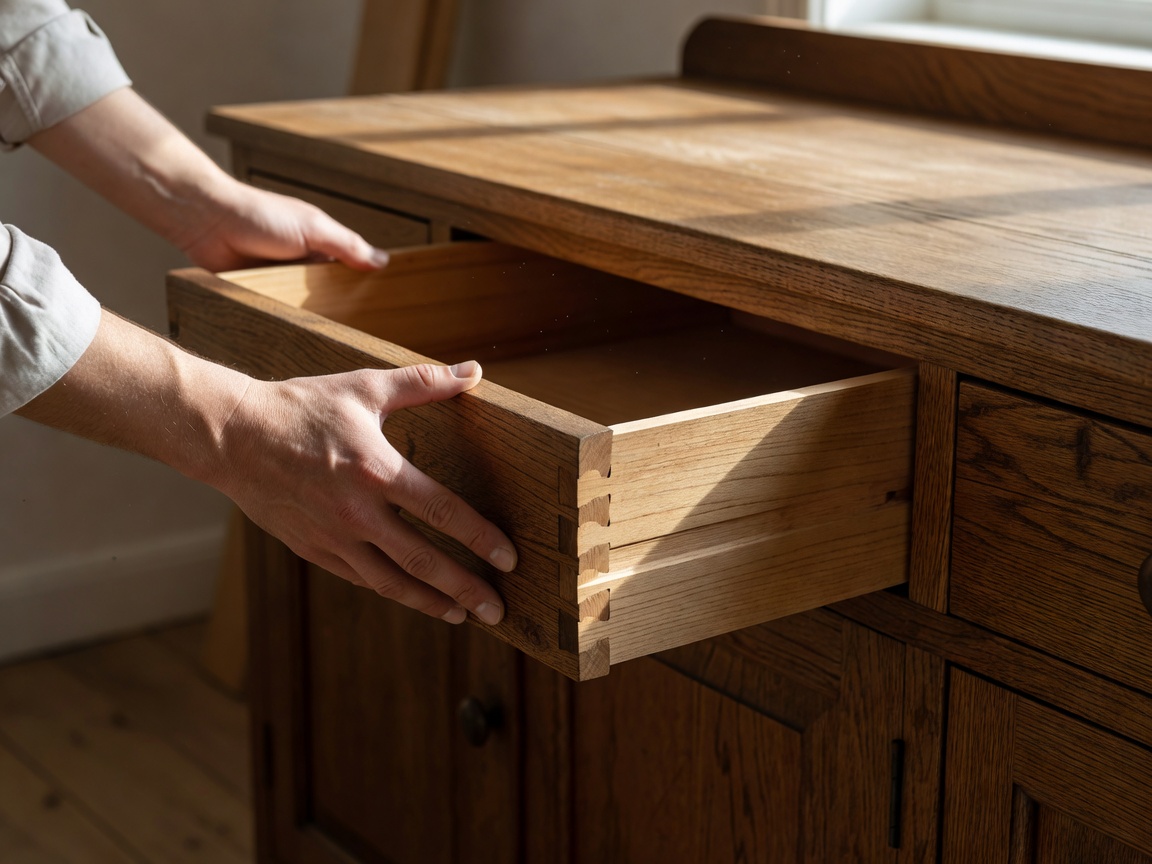
- Drawer joints: dovetails indicate careful construction. Stapled drawers suggest lower quality.
- Runners: drawers should glide. Sticking runners can often be fixed with candle wax.
- Back panel: look here and inside drawers for labels, stamps or retailer marks.
- Legs and plinth: check for splits where legs meet the carcass.
Furniture anatomy
Reading a chair
- Seat height: most dining chairs sit around 43 to 46 cm. Check it against your table.
- Joints: rock the chair gently. Movement at the joints is common and usually repairable.
- Seat type: drop-in seats lift out and are simple to reupholster at home.
- Frame timber: beech, elm, teak and oak behave differently; note which you have before finishing.
- Webbing and springs: sagging webbing is cheap to replace; broken frames are not.
If a chair is comfortable to sit in for twenty minutes in the shop, it will probably earn its place at home.

A quick buyer’s checklist
Use this when you view a piece in person.
| Check | Good sign | Think twice |
|---|---|---|
| Smell | Faint wood or wax | Strong damp or mould |
| Small holes | Old, dark and dusty-free | Fresh pale dust beneath holes, which may mean active woodworm |
| Veneer | Flat and intact | Large blistered or missing areas |
| Stability | Slight movement | Cracked legs or split rails |
| Drawers | Slide with light effort | Bases broken or missing |
| Labels | Present and legible | Absent, which is not a fault but limits dating |
Placing a piece so it feels at home
Proportion matters more than provenance in daily life. A tall dresser crowds a low-ceilinged cottage room, while a long, low sideboard can make the same room feel wider. Measure your walls and windows before you shop, and note the height of window sills, radiators and sockets.
Give a good piece breathing space. A clear strip of wall on either side of a sideboard lets its shape read clearly. Keep the top lightly dressed: a lamp, one larger object and a small group of three is usually plenty.
Mixing woods is fine. Pair a warm teak sideboard with a pale beech chair or an oak floor by repeating each tone at least once elsewhere in the room, for example in a picture frame or a bowl. That repetition stops the mix from looking accidental.
Finally, remember that famous names attract reproductions. Classic designs such as Wegner’s Wishbone chair, Jacobsen’s Series 7 and the Eames Lounge Chair have been widely copied. If authenticity matters to you, check maker marks and seek specialist advice. If it does not, buy what is comfortable and well made, whoever designed it. When it is time to care for your find, our repair notes start gently.